Radical listening Week Members’ Meeting - Leadership. Power. Accountability.
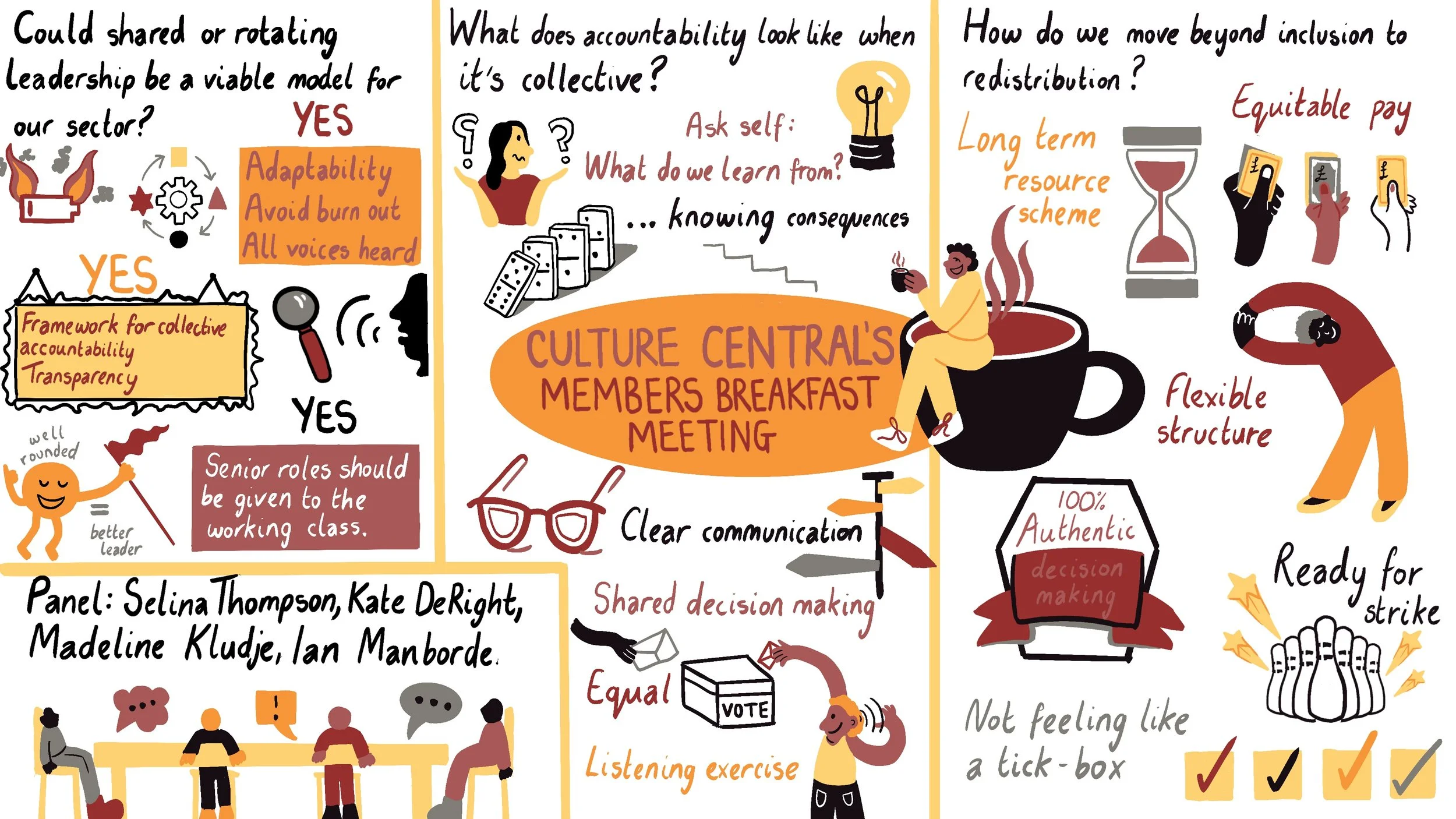
Illustration by Millie Yarwood
We asked: What happens when we do things differently?
As part of Radical Listening Week, Culture Central brought members together for a focused conversation on Leadership and Governance. These Members’ Meetings are more than networking opportunities, they're a space for cultural professionals across the region to reflect, build shared understanding, and shape the future of the sector together.
This particular session was slightly different as it was designed not only to reflect but to inform. The insights shared here will directly feed into Culture Central’s Charter for Equity, a collective commitment to fairer working practices across the West Midlands’ cultural sector, shaped by the sector itself.
The session was chaired by Selina Thompson, and featured a panel of Culture Central members:
Ian Manborde – Midland Regional Official at Equity and Culture Central Board Member
Madeleine Kludje – Deputy Artistic Director, Birmingham Rep and Culture Central Board Member
Kate DeRight – Creative Director at Spectra
We began with a question that many organisations are already navigating in practice: could shared or rotating leadership work for the cultural sector?
Kate DeRight shared how Spectra has embedded a collaborative approach into its structure:
“We don't have a top-down management structure… Everyone in our team, whatever their role is, they’re the lead in that role.”
This supports that shared leadership can works but it needs care, clarity and resources.
Madeleine Kludje reflected on the benefits of co-leadership in larger organisations and why it matters:
“When you have two or three people at the top, there’s a consensus that feeds into it. You reduce burnout and build adaptability. You’re not making decisions in a silo.”
There was consensus that shared leadership when designed well can enable more sustainable and democratic working, but the conversation also recognised the need for resource and support. The panel agreed that this model must be intentional, not a token structure. Shared models must be supported with time, training, and thoughtful design.
From there, the panel explored what accountability looks like when responsibility is shared.
Kate pointed out how this plays out practically:
“There has to be someone who says, ‘Right, this is the thing we’re doing’… We talk about our work being a learning environment. The things that go wrong are the things that help you figure out how to do it differently.”
In Spectra's approach, leadership is about clarity, direction, and shared ownership of process.
Madeleine added:
“There's something about really clear communication, also collectively understanding. What do we define as success? Because when that isn't clear, it can go everywhere. There needs to be a listening exercise of those internally in the organisation, as well as externally, so that you are on the same page of moving towards something together.”
“There's something about building of mutual trust when you are in a collective.”
That call for shared clarity extends beyond teams and into boardrooms. Ian Manborde asked us to reflect on the role of governance in learning from failure:
“It would be good if enough questions were asked periodically... ‘What do we learn from that? What does it tell us about good governance (or not) within the organisation?’”
It was a reminder that leadership isn't only about who’s in charge, but about how we respond when things go wrong, and how we make space to learn from it. Sharing responsibility doesn’t mean avoiding responsibility, it means defining it together. What we take from this is that collective accountability needs clarity, reflection and a shared purpose.
The conversation then turned to how we talk about success, and who we credit when things go well.
One of our listening members raised a common dynamic in arts organisations:
“I was just thinking about how the term being held accountable is always fairly negative, and that if you are doing distributed leadership in any sense, the leader with the big L is keen to point out that somebody has taken a risk, has gone too far, has done something wrong… But then when things do go well, a lot of the time the heat, the praise, is heaped on the person with the fancy job title...”
This prompted reflection on how success is often seen through a hierarchical lens even when the work is delivered collectively. It was a reminder that redistributing power also means redistributing recognition. This matters not just for fairness, but for morale, trust, and retention, especially in sectors that rely so heavily on freelancers and project-based teams.
That led naturally into the final provocation: how do we move beyond inclusion to actual redistribution of power?
Ian was clear about what’s at stake:
“This sector has the lowest proportion of working-class people in it, and an even lower, still, proportion of people in leadership positions. We recently launched our class manifesto now working bodies like Channel Four, UK theatre on this because it's not an issue that we can fix, because we're not in charge of how the industry runs.
…There are explicit decisions that are made based on networks that some people get in and some people don't, and it's a worrying thing.”
Kate challenged the language of inclusion:
“We’ve got a little bit of discomfort with the word ‘inclusion’… It sounds like, ‘I’m here and I’ll let you in.’ That’s not what we’re looking for.”
This wasn’t just a critique. It was a call to genuinely redesign the systems we use to make decisions, set priorities, and invest resources. Redistribution means changing the balance of power, not just inviting people into the same old room. Representation is not the end goal here; we need to build structures that hold new kinds of leadership.
Equity in Action
At Culture Central, we know that leadership must reflect the equity we seek. That’s why we’re investing in action. Members’ Meetings are not just for networking and discussion, they help shape our work.
Our Leadership Associates Scheme supports individuals from traditionally excluded backgrounds to build their leadership practice, with paid opportunities to shadow, learn and contribute to our organisational strategy.
Our Collective Leadership Programme helps develop individual cultural workers to discover, experiment and rethink how they lead, make decisions, and centre equity in their leadership.
The insights from Radical Listening Week and this Members’ Meeting will help inform the Phase 2 of the Charter for Equity.
Be part of it
Culture Central’s membership is open to anyone working in or with the cultural sector across the West Midlands. Whether you’re a freelancer, organisation, or collective, becoming a member means:
Access to sector-shaping conversations
Opportunities to share, influence, and learn
A space to connect with peers committed to change
Join us to help shape what leadership looks like when we mean it.
Become a Culture Central member