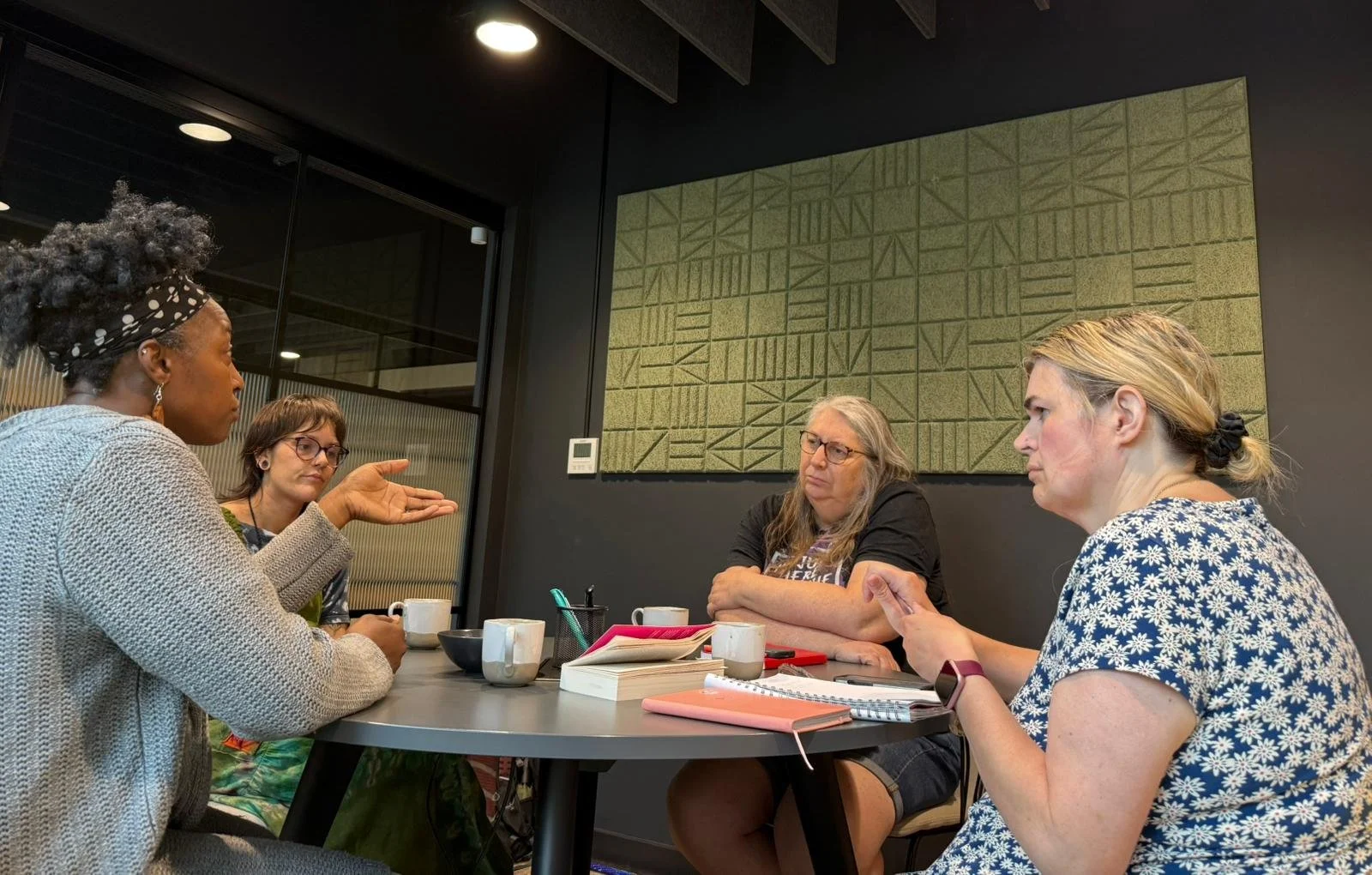
Monica, Hannah, Fee and Mel - Stoke Exchange Forum, image by Jessica Royall
Guest blog post for Radical Listening Week 2025, by Kat Hughes
Interviews and original writing by Mel Osbourne
I’m Kat Hughes, a theatre director and producer based in Stoke-on-Trent, and I run the Stoke Exchange Forum, a growing network of artists, freelancers, and cultural workers who meet regularly to share resources, challenges and ideas. Stoke-on-Trent has long been defined by its working-class communities and creative grit, but we are more than pits and pots.
The city today is home to thriving makers, musicians, digital artists, writers, and designers. According to ONS data, Stoke has one of the highest rates of economically disadvantaged populations in the West Midlands, and yet, it continues to produce nationally recognised talent and ambitious grassroots projects. And yet, as we celebrate a legacy of making, many artists in the city still struggle to make ends meet. Inclusion, equity, and access remain urgent questions for those trying to build sustainable creative lives here.
As part of Radical Listening Week, supported by Culture Central and Arts Council England, writer Mel Osbourne conducted interviews with three Stoke-based working-class creatives, Fee, Monica and Hannah, to explore these questions. In this article, I reflect on their words, shared with permission, while weaving in my own experience as a producer, freelancer, and forum facilitator. Mel’s interviews gave space for honest accounts of survival, creativity and exclusion. Here, I want to explore how those accounts link to the wider systems we’re all navigating. Their words, published here unedited, speak volumes about what it means to work in the cultural sector when access to money, space and opportunity still feels conditional.
Monica’s words, “here’s a coded way people communicate because they’re in certain spaces. The effort it takes just to get into the room is exhausting”, reflects a wider truth that resonates beyond individual experience.
As Monica also noted, “If we think culture is something that everyone has access to, that’s when it becomes harmful , because there are already barriers.”
Cultural industries rely on the visibility and energy of freelancers, but often fail to provide the stability or equity required to sustain them. Nationally, only 16% of people working in the arts come from working-class backgrounds, a figure that raises serious questions about who gets to participate in shaping culture. In cities like Stoke-on-Trent, where infrastructure and access have been historically under-resourced, those barriers become even more entrenched.
Invisible labour, from emotional support to writing endless applications, often goes unpaid. Monica’s comment, “I genuinely feel there are circles in Stoke that pull down beautiful amounts of money, but it doesn’t feel like it filters out”, captures the frustration of doingmore for less. Hannah added, “I feel I must be invited to talk or engage. I’m scared to speak unless I know it’s safe or I get a signal that I’m welcome.” Daily rates are questioned while the unpaid prep work, access adjustments, and post-project care remain uncosted. And still, we hear calls to “just apply,” “just network,” “just push through.” But many are already pushing harder than anyone should have to.
That’s one of the reasons the Stoke Exchange Forum was formed, not just to talk, but to act. Fee’s reflection, “Stoke isn’t hard to reach, people just don’t walk that far. It’s knowing the right door, and feeling like someone wants you to walk through it”, speaks directly to the importance of infrastructure that actively welcomes and supports creatives. Hannah also spoke to this reality: “I’m happy to live how I do, but I don’t know about the future.” As producer of the forum, I’ve tried to create a space where freelancers and organisations meet on equal footing, where people feel able to name job insecurity, ask for work, and know they won’t be judged for it. It isn’t a fix, but it’s a start. We keep our resource costs low so we can invest more in people. We share contacts. We listen and respond. We support things that lead to actual jobs, collaborations and commissions. It’s slow work, butit’s building trust.
As one participant reflected in Mel Osbourne’s interviews: “Too often, arts organisations want community involvement but not community leadership.” That stuck with me. But it’s worth interrogating this idea. Should all organisations be community-led? Would we be asking that of national institutions in London or Manchester, or is it the scarcity in Stoke that makes us feel success must be redistributed rather than scaled? Perhaps the bigger challenge is to think differently: not as competitors, but as collaborators, recognising that one organisation’s success can be the city’s success too. As Fee reflected, “If change comes, maybe it’s not for us, maybe it’s for the next ones. But that’s what you want, isn’t it? Culture creates free thinking. Society needs that to advance.” It’s only when we move out of survival mode that we can begin to share power meaningfully, without fear of losing our footing.
The Charter for Equity, developed by Dr Lucy Lopez and referenced throughout Radical Listening Week, pushes us to ask: what if every project had to include a baseline for equity, for access, rest, flexible working, and caregiving? These questions echo what Monica described in Mel Osbourne’s interviews: the emotional toll of trying to get to the table, the frustration of seeing funding that doesn’t filter to the edges, and the exhausting effort it takes to simply stay visible. What would change if we truly costed that labour?
And in a city like Stoke, what would it cost to make those conditions real? For even a modest co-created project, supporting four artists across three sessions, factoring in access support, prep time, rest, and care could mean increasing the budget by 15 to 30 percent. This uplift allows for more ethical working conditions, and while not a small ask, it’s essential if we’re serious about equity as a baseline rather than a bonus.
None of us can answer that alone. Hannah’s comment, “I’m happy to live how I do, but I don’t know about the future”, stays with me. It’s a reminder that we can’t keep expecting creatives to sustain their practice through personal sacrifice. By listening with care to those whose voices are often left out of decision-making, we can start to build fairer systems.
This year, across Stoke-on-Trent, we’ve seen grassroots networks flourish, from PICL’s Creative Educator Network to Connects and Centre Space’s cultural meetups. We’ve seen local organisations experiment with new ways of working.
Radical Listening is about being willing to act differently afterwards. As the Equity Charter work progresses, I hope we continue creating space for honest conversation and shared decision-making, so more of us can make a life not just a living through creativity in this city.
The Exchange Forum isn’t perfect, but it’s trying.
So, what are the next steps? We need consistent funding that recognises the true cost of ethical creative practice. National funders must invest in long-term, local knowledge. Organisations need to share decision-making, and artists should be resourced to lead, not just participate.
To level the playing field, financially and culturally, we need layered solutions. Micro-commissions matter. So does training, mentoring, and the chance to work nationally. Local networks help people build skills and confidence. National opportunities shift perceptions and bring longer-term financial security.
Micro-commissions matter. So does training, mentoring, and access to national work. Local networks help build confidence and community, but national visibility helps shift perception, raise standards, and secure financial sustainability. If we want equity, we need investment that recognises all parts of the ecosystem and makes space for those who’ve historically been left out.
This guest blog post is for Radical Listening Week. Radical Listening Week is led by Culture Central, and supported by Arts Council England, with the purpose of making a more equitable cultural sector in the West Midlands.