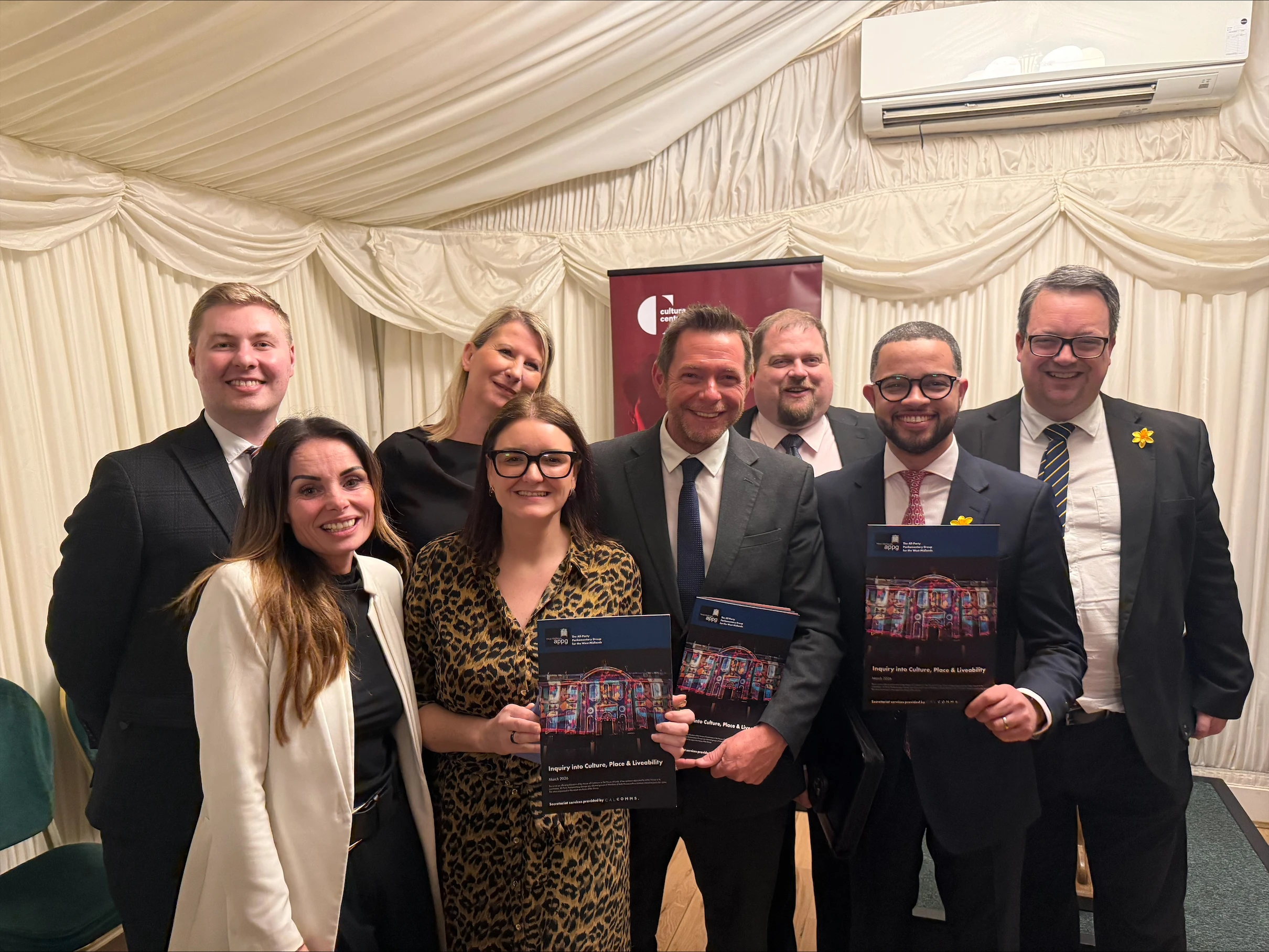
On Wednesday 4th March Culture Central attended the first ever Parliamentary Reception for the All-Party Parliamentary Group (APPG) for the West Midlands. This event marked an important milestone for the group and an opportunity to bring together political leaders, partners and stakeholders who share a commitment to the future of the region.
A key highlight of the evening was the official launch of the final report from the Culture, Place and Liveability Inquiry. The report brings together months of research, consultation and evidence-gathering, exploring how cultural activity, creative industries and local identity contribute to the economic vitality, wellbeing and long-term sustainability of communities across the region.
MPs from across the West Midlands attended the event including: Dave Robertson (MP for Lichfield, Burntwood and the Villages), Adam Jogee (MP for Newcastle-under-Lyme), Leigh Ingham (MP for Stafford, Eccleshall, and the Villages), Mike Wood (MP for Kingswinford & South Staffordshire), Jacob Collier (MP for Burton and Uttoxeter), David Williams (MP for Stoke-on-Trent North & Kidsgrove), Antonia Bance (MP for Tipton, Wednesbury and Coseley), Warinder Juss (MP for Wolverhampton West), Manuela Perteghlla (MP for Stratford-on-Avon), Dr Julia Buckley (MP for Shrewsbury), Laurence Turner (MP for Birmingham Northfield), Sureena Brackenridge (MP for Wolverhampton North East), Taiwo Owatemi MP for Coventry North West), Josh Newbury (MP for Cannock Chase), Rachel Taylor (MP for North Warwickshire and Bedworth), Jodie Gosling (MP for Nuneaton and the Villages), Allison Gardner (MP for Stoke-on-Trent South), John Slinger (MP for Rugby), Daniel Aldridge (MP for Weston-super-Mare).
As Chair of the Culture, Place and Liveability Workstream, Culture Central CEO Erica Love spoke at the event. Here’s what Erica said:
Our research recently found out that 70% of people in the West Midlands feel that they are a creative person, on top of that 50% of people in the region want to do more things to be creative – being creative…. taking part in Culture…. being an audience member….. is important to the people of the West Midlands – they value it.
The West Midlands cultural ecosystem stands at a pivotal moment. Evidence from this inquiry reveals a fragile skills pipeline, stark inequalities in cultural access and a significant funding and infrastructure gap that threatens to limit both the region’s growth and quality of life for people across the West Midlands.
Culture is not a ‘nice to have’ but a vehicle for driving growth locally and nationally whilst also delivering significant social impact.
The West Midlands Culture Sector is ambitious, innovative and collaborative. We know that over 10 towns across the region are planning to bid to be the first Town of Culture - speaking volumes about the importance of creativity and culture right across our region. We heard from a range of organisations across the region through our evidence gathering sessions - for example, we heard about the ambitious plans Birmingham Hippodrome has to create a UK Centre for New Musical Theatre here in the region. We heard how Stoke on Trent, Worcester and Sandwell are working in partnership with their Cultural Compact to embed culture in broader local authority strategy through the implementation of a joint cultural needs assessment. Brook Arts hub in Stratford-upon-Avon shared with us their remarkable work in reducing social isolation and providing a place for everyone to be creative.
Throughout the evidence gathering we heard countless stories of the fantastic cultural work happening in schools and at the heart of communities making a significant impact on health, well-being, pride of place and cultural vitality.
The West Midlands possesses distinctive assets with the potential to redefine its cultural future — from world leading institutions to powerful place based partnershipspoised for scale.
For the inquiry we structured the findings around three core priorities identified at the outset –
engaging young people and strengthening skills pathways
broadening access and participation
and unlocking more effective and equitable investment.
The evidence points to a clear conclusion. The West Midlands does not need a wholesale reinvention of cultural policy. It needs your support to enable more coordinated, place sensitive and long-term action that builds on what already works.
1: Culture is not a statutory responsibility making it easy to fall by the wayside. We must use current governance shifts as a one off opportunity to Hardwire Culture into Local Government Reorganisation by establishing a statutory Place & Culture Board (Cultural Compact). This board will oversee a mandatory Joint Cultural Needs Assessment (JCNA) and Cultural Strategy, ensuring that culture, heritage reuse and liveability are not “add ons” but are baked into the DNA of new council structures.
2: Too many young people are unable to access creative careers, so the inquiry recommends developing Specialist Skills Pathways in partnership with existing skills providers to co-develop a Specialist Skills Programme. Specifically to address: innovation in creativity, capacity building and business development, knowledge exchange and practice development.
3: To secure and develop the region’s vital cultural infrastructure for the future. We recommend that Local Authorities have a statutory responsibility to align planning policies. This includes ringfencing Section 106 and Community Infrastructure Levy (CIL) contributions specifically for new and innovative cultural infrastructure that drives growth and widens access, including affordable creative workspaces and the protection of “social anchors” like local artists, libraries and community hubs.
4:To lever investment the inquiry recommends formalising cross sector partnerships and the creation of mechanisms for blended finance models involving philanthropy, business and social investment.
5: To ensure equitable access to culture for young people and those in rural areas, we recommend the introduction of a Culture Access Pass providing financial support for young people in deprived communities to experience cultural activities, and work with transport providers to develop low or no cost travel options for school visits and cultural engagement.
6: To ensure the region retains creative talent we should develop region-wide standards for fair and inclusive work through Shared Charter for Pay Fairness and Equity – this recognition scheme would improve working conditions across the creative workforce.
7: To ensure the region is investment ready, we should develop a Long Term Cultural Investment and Data Framework ensuring consistent principles for economic and social value assessment.
I want to thank the members of the APPG, the advisory board and CalComms for conducting this inquiry, to all the people who submitted evidence and I look forward to working with you to take these recommendations forward, so we can collectively create opportunities through culture, for the people and places of the West Midlands.