Burnham's Rewiring, Devolution, and Culture
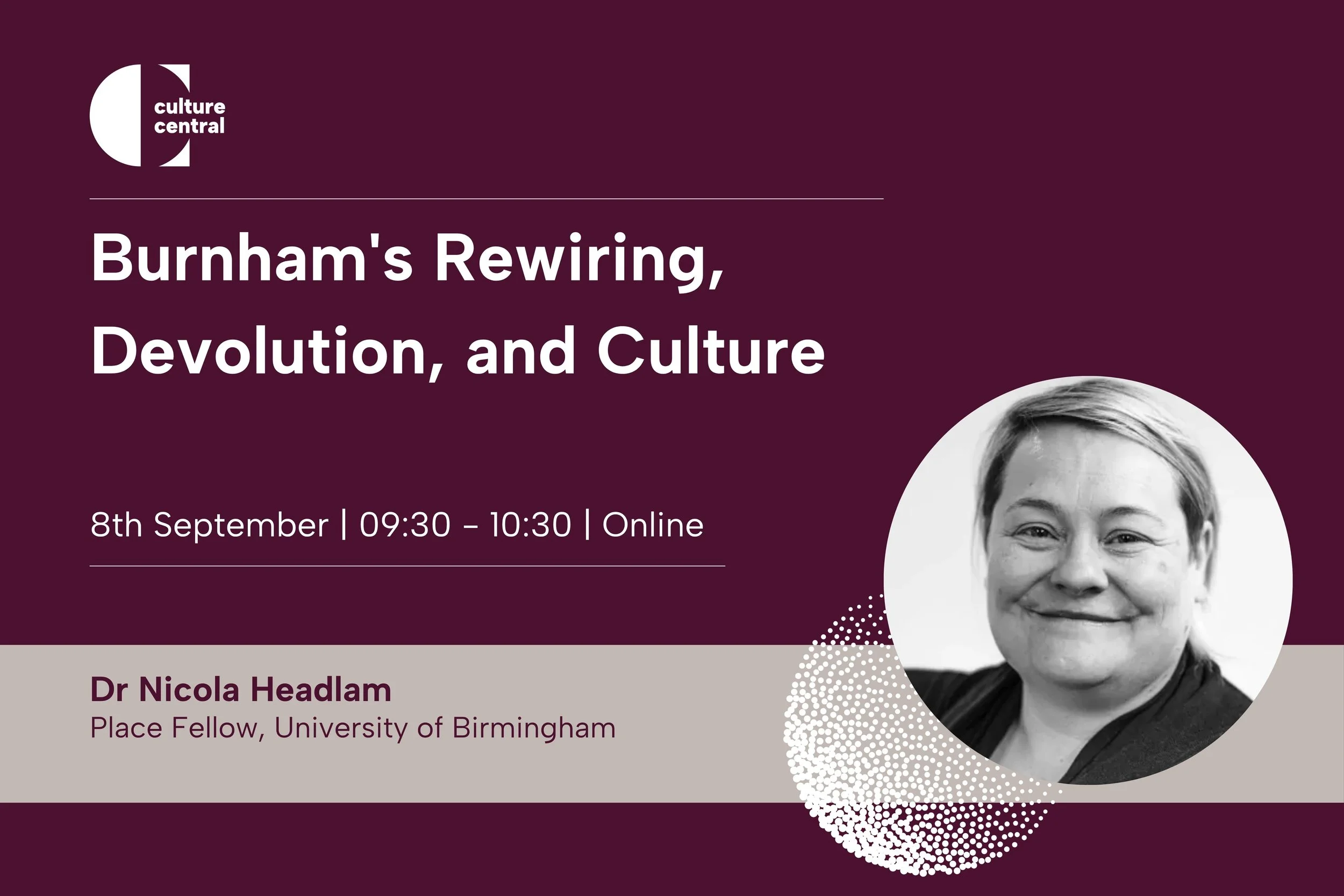
For the September WMCRU session, we’ll be joined by Dr Nicola Headlam, a Place Fellow at the University of Birmingham and an expert in place policy:
We're living through what feels like the biggest wave of devolution talk in a generation. In the space of a few weeks this summer, Andy Burnham put out a "Rewiring the State" Cabinet statement, revived the National Economic Council with mayors as standing members, and reopened the argument for a written UK constitution. Buried in that wave is a shift in how cultural policy and funding get made and brokered between Westminster and places like the West Midlands. Arts Council devolution isn't a footnote to this story — it's a live test case for whether "rewiring the state" means real power and resources moving outward, or just another rebrand of who signs off on what.
On 8th September I want to do three things: sketch what's actually new about this moment versus the last three decades of devolution promises; be honest about the fiscal reality Burnham's inherited, which is considerably worse than what Gordon Brown had to work with in 2009; and then get specific about culture — where organisations like Culture Central sit in this, and why brokerage bodies that can translate between national policy and local delivery are going to matter more, not less, as this settles.
Dr Nicola Headlam has more than 20 years of experience working within all aspects of the multi-helix innovation system; central and local government, civil society and campaigning, academic research and knowledge mobilisation and in industry. Along the way, she has honed expertise in urban and regional subnational economic development, the roles of government in making and shaping place, and in data and evidence for transformation.
In 2024, she became a freelance economic advisor on the role of leadership and partnerships, urban and living lab forms for research, future of cities and foresighting methods, urban transformations, place-branding and urban regeneration and the spatial consequences of public policy.
She works on the intersection of governance with economic development and the importance of institutions in infrastructure, and has broad experience of the limits of weak and improvised structures.
She is passionate about the potential of subsidiarity to and through reformed local government to remedy some of the egregious inequalities of the UK and is hopeful that recast central-local relations, rooted in strong evidence and partnerships for pro-place policy and implementation, hold the key to socio-spatial disparity.
This WMCRU session follows on from our recent advocacy and positioning paper which sets out the work we're delivering as the cultural sector here in the region that directly contributes to the Prime Minister’s policy priorities. Read it here.
Getting involved
These meetings take place online at 9.30-10.30am on the second Tuesday of every month. If you would like to join the learning sessions, please sign up using the form linked below or email info@culturecentral.co.uk.
We aim to facilitate and accommodate all accessibility needs. Please do let us know below if you have any specific questions, needs or comments and we will do our best to meet them.
About WMCRU
Set up during COVID, our regular West Midlands Culture Response Unit (WMCRU) meetings were a vital lifeline for the sector in connecting, sharing and getting practical information and advice. WMCRU has continued to be a useful space for organisations and individuals that Culture Central continues to support as a collective and collaborative space for all those that are interested in the cultural ecology of the region. In 2026-7, WMCRU meetings will explore key strategic challenges and opportunities that affect the sector and the region.